Introduction
In recent years more criteria points are accepted by admission officers to elaborate students, and past few years were tightly related to the rapid increase of the number of extraordinary changes in this field. Many colleges, especially selective ones, expect international and domestic students to take advantage of opportunities such as exams, projects and research works their schools may offer to challenge themselves in applications (John Willey, 2023). In addition, one of the universities in top 100 of the world rate, Nazarbayev University requires: IELTS Overall: 5.5; Minimum: 5.5 in Writing and Reading, 5.0 in Listening and Speaking (Regular Admissions — nu.edu.kz). However, these activities and exams are hard to combine with school for teenagers of 13–18 years old. In my school I see many students who are burned out by trying to combine their school, start-ups with preparing for exams, or cannot even stay calm in a competitive environment. In my opinion, requirements for students who will graduate should be less strict and ambitious.
Literature review
This study mixed methods to approach to understand how university admission requirements affect the competitiveness of school graduates of 11–12 grades. A combination of quantitative surveys and qualitative interviews was selected to select both measurable trends answering aim questions and get some special information from experts in the field of university applications observers. Two methods were crucial to convey different perspectives of many resources and methodology works. Whereas surveys allowed access to broad data across a larger sample of students in a range of two grades, interviews provided deeper inclusion into individual experiences of academic pressure due to endless competitions.
Some relevant and subjective research works were found, but to avoid being biased, all those authors were checked for commercialism because nowadays applying for universities has become a source of income. Research work from Polygence was mainly about how research projects make students stand out to universities with high competitiveness levels. Other studies from the American Economic Association showed that raising admission requirements are able to improve college enrollment rates all over the world. To understand the real situations of all these counteractions, decisions that get more information from real people like 11–12 grade students and professional workers in the admission sphere are needed were made.
Using all those methods is essential because they answer different parts of my research question. Surveys will give me patterns of quantitative data from the group of people who are mainly affected by competitiveness and graduates. Interviews alone would have given me depth of qualitative data of the experts’ past and present experiences of their students’ enrollment cases. Together, the methods will let me check whether student experiences match what professionals observe, and all these investigations will make my findings more reliable and able to connect them with the resources.
Aim
The key term of this research paper will be competitiveness, which means the level of how taught it is to apply for universities and get accepted.
This research explores the consequences of the high admission requirements of universities to the competitiveness of school graduates because it is an essential problem. From my own experience and exploring the school atmosphere, I was interested in the issue of increased admission requirements when students compete at higher rates and knew that the effect of this could be quite complex. The aim of the research was therefore to find out how the high admission requirements of universities affect the competitiveness of school graduates.
Therefore, in this research the main questions to research are:
- What are the main causes and consequences of the uplifted admission requirements of universities?
- What are the barriers to decreasing application requirements in modern realities?
- How many times have more young scholars are affected by the increased application to demand pressure according to their feelings in the past 5 years?
- What are the minimum standardized exams’ scores requirements needed to pass through the admission process in young scholars’ opinions?
If undergraduates choose higher than usual level scores in exams such as IELTS and SAT, then they will show higher rates of negative emotions affection like anxiety. The outcomes of the research were intended to increase understanding about the need for high admission requirements of universities and acknowledge its effects to school graduates.
Methods
A primary argument states that high standards channel students’ efforts, enhance competitiveness by fostering a culture of being perfect and prepared for everything. These requirements act as a signaling mechanism, where students invest in human ability such as advanced course works, test preparation for SAT and ACT, and leadership projects to distinguish themselves in a crowded market of profiles within university applications (Polygence, 2023). For example, increasing high school graduation requirements more can improve initial college enrollment rates, which suggests that structured obstacles in student’s pathway support the rise of overall competitiveness (American Economic Association, 2020). Furthermore, elite institutions like Harvard College have a mandatory complicative application structure to identify students who will be the best educators of other students, showing that the competitive filter selects for high achievers and collaborative groups of students (Harvard College, 2023). Hence, these agree with human capital theory, doubting that the process of meeting these demands builds skills valuable for university and beyond this pursuit.
In contrast, a significant body of evidence suggests these demands often undermine the expected competitiveness universities seek to measure, mostly through improving students’ psychological strain and access. The pressure to support high GPA maintenance, standardized testing (with MIT's average SAT score near 1550), and prestigious extracurricular leads to widespread student burnout phenomenon that is readily observed in secondary school environments all over the world (NextGen Admit, 2023). This creates a systemic barrier where «opportunities to challenge themselves», which is mostly valued by higher education system, are not equally accessible among the students, which interrupts a cycle of advantage (Willey, 2023). It reveals that chronic stress can impair the cognitive function and motivation of teenagers, ultimately diminishing a students’ capacity to perform at their peak state, when it is highly expected. For instance, study on postgraduate students in CIS found the fact that states while entry requirements predict academic performance, their predictive power is limited; hinting that the intense focus on pre-admission requirements may overlook long-term learners who were stifled by the competitive gauntlet (ResearchGate, 2022). Therefore, this system privileges students from resourced backgrounds who can afford test preparation courses, application consultants assistance, and exotic project opportunities in other cities or countries, thus equating competitiveness with wealth rates rather than pure merit or potential of students themselves.
On the other hand, the problem is not about high standards, but it is about their homogenization, which means that people think in only one way, at all and intensity. The requirement for a narrow band of excellence, just like Nazarbayev University’s IELTS minimum scores, may illustrate diverse forms of talent and intelligence that students may desire to present (Nazarbayev University, 2023). However, the counterargument suggests that any selection system will create pressure in anyways, and that the current system is a tool for managing many applications at Universities such as Stanford that admits less than five percent of all applicants each year (Edurank, 2023). As an example, arguments connected with the burnout and inequality are supported by direct sociological and psychological research works, such as studies linking stress to academic demands made by university admission officers (PLOS ONE, 2022). This is the signaling argument, which is right only in theory, but it often fails in practice in real life, as it contracts the ability to illustrate readiness through expensive educating programs. In this case, the strength of this argument makes the understanding of negative psychological impacts and issues appear as more complicated and immediately observable to researchers, whereas it affords sustainably high level of competitiveness that allows students to stand out of the crowd.
Results
Quantitative data
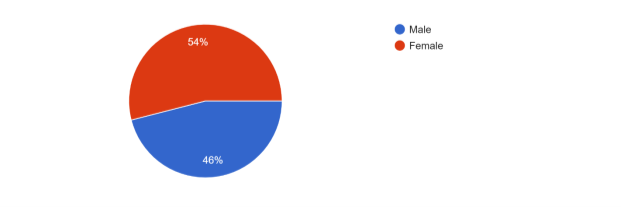
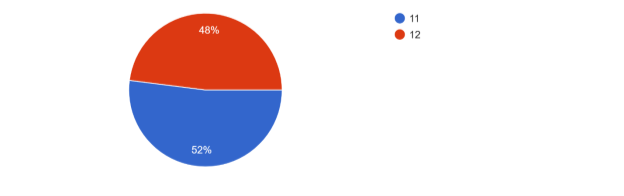
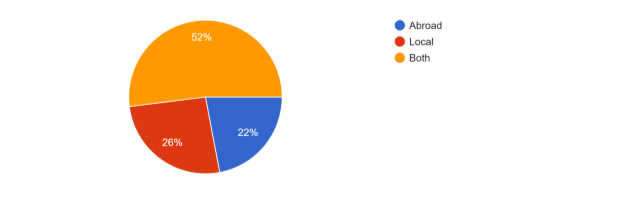
Discussing application profile, the survey respondents are approximately equally balanced by gender (Fig. 1). In terms of academic background, the situation is similar, 52 % of students are in grades 11 and 48 % are in Grade 12 (Fig. 2). Ambitions are clearly seen in the graph as 52 % of students plan to apply to both local and international Universities (Fig. 3).
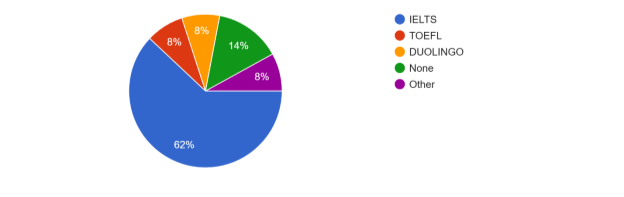
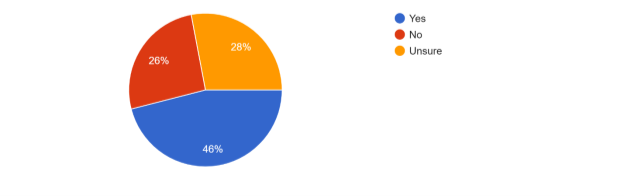
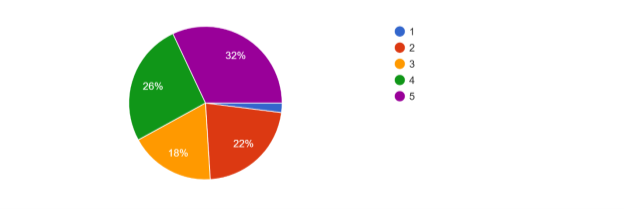
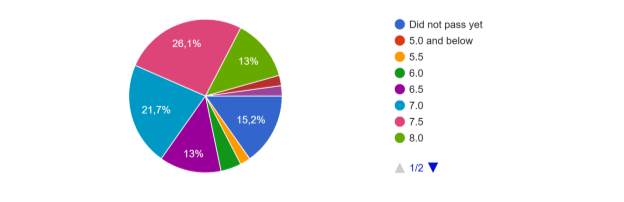
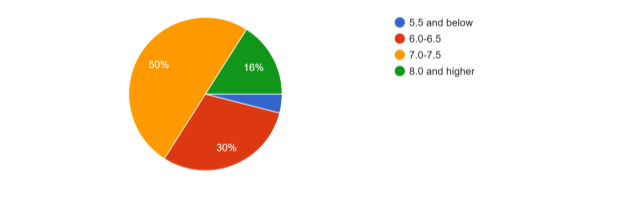
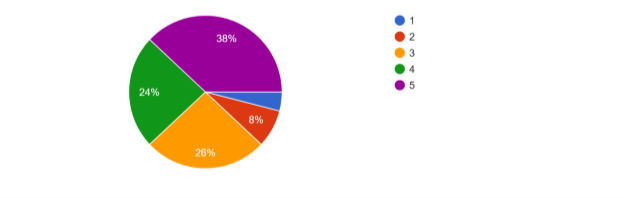
When it comes to standardized testing and competitiveness, 62 % chose the IELTS as their preferred standardized test (Fig. 5). However, 50 % of students believe a score of 7.0–7.5 is the minimum for admission, which is a high proficiency level for graduates (Fig. 10). Current data that was collected shows that only 26.1 % have already achieved a 7.5, while just 13 % have got 8.0 band score (Fig. 9). 38 % of students view these years’ environment as highly competitive by rating the increase in competition in admissions for universities and colleges over the last five years, 5 out of 5 (Fig. 11). Nevertheless, 46 % of responders feel these high requirements are motivating them (Fig. 6), but many believe the standards are «unbelievably too much for teenagers» according to their words.
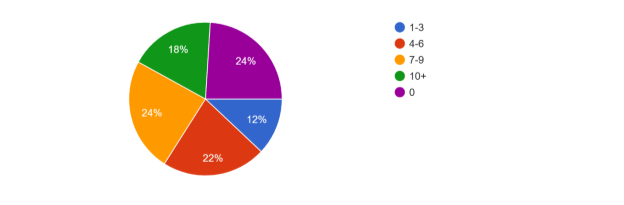
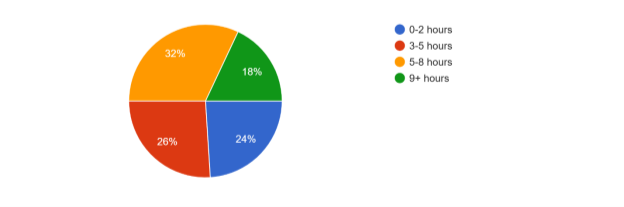
32 % of respondents spend 5–8 hours studying (Fig. 12). A major challenge cited is «huge amounts of homework from non-core subjects» with the preparation for entrance exams such as SAT, PSAT and ACT and IELTS that were mentioned in many written answers to open-ended questions during the survey.
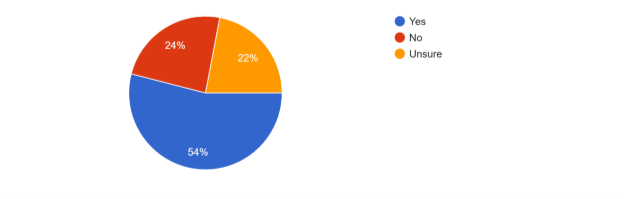
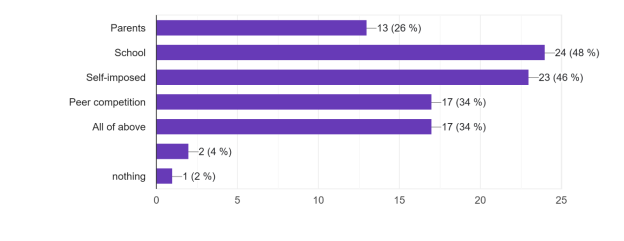
Impact on well-being and pressure sources of competitiveness is shown by 32 % of students reported at the maximum stress level of 5 (Fig. 8), and 54 % confirmed they have experienced burnout symptoms (Fig. 13). The primary sources of this pressure are School (48 %), Self-imposed (46 %), Peer competition (34 %), and Parents (26 %) (Fig. 14). The qualitative feedback illustrates reports of students who are suffering from insomnia, headaches, and damaged eyesight. Many responders have abandoned their favorite hobbies and sports sections, and some feel «closed», «aggressive», or «obsessed with applications».
Qualitative data
For Q1, from a career counsellor’s view Madina Kazhakhmetova, who is working for two years as a profession counselor at NIS Taldykorgan, these students that she worked with are captured by stress, burnout, and inequity linked to admission requirements when they in parallel feel too strong academic pressure and responsibility about their whole future. As an answer for the Q2 miss Madina suggested that students have many barriers in their minds formed by chronic stress and anxiety about applications, while Universities offer useful trends, students and graduates, who are just young teenagers, thrive and reveal deep mental issues. From counselor's professional experience, current university admission requirements shape student competitiveness both positively by offering more motivation to outstand in the crowd and negatively adding too high expectations on 16–18–year-old young people(Q3). According to her words, if a more balanced set of professionals, students and parents also explore support systems and student resilience, then they will be able to help the graduate overcome all problems during applications season and even before the burning out started occurring. Her advice for universities to solve some of problems connected with admission period is to expand collaborations from The Universities’ side with schools to prepare graduates for their system and get used to the interactions between admission officers and students (Q4).
Discussion
The results section of this study demonstrates a complex relationship between high University admission requirements and the competitiveness between young school graduates. On the one hand, according to my arguments on research paper high standards serve as a powerful mechanism, compelling students to invest in their human capital and portfolio, which is supported by the fact that 46 % of surveyed respondents find such competitive environment mostly motivating. Consequently, the competitive atmosphere effectively stimulates the development of skills necessary for higher education in colleges or Universities for students. On the other hand, the research investigates these patterns to illustrate meaningful conclusions by using 12 sources, but when I started exploring the theme, there were 25 sources with well-constructed arguments. Regardless, after RAVEN method usage to leave the most reliable ones, there were some authors with commercial vested interest, and they were not added to the research. The strong part of my research paper is the usage of official admission information from current academic years of famous Universities about their acceptance percentages and average required scores.
This research has taught me that high admission requirements are not simply beneficial or full of pitfalls because they become motivators for some students and health damager for others. The finding that self-imposed pressure (46 %) nearly equals school pressure (48 %) was so unexpected for me, I understood that students undergo stress due to competitiveness even without external pressure but due to themselves. Despite high levels of ambition, there is a significant gap between expectations and reality which confirmed my biased idea that students’ expectations about standardized test scores are too high. While 50 % of students believe an IELTS score of 7.0–7.5 is the minimum requirement for admission, only 26.1 % have achieved a 7.5 score band, and it demonstrates the difference between students’ mindsets and real life. This type of pressure leads to 54 % of respondents experiencing burnout symptoms, and one-third of those surveyed rating their stress at the maximum possible level of 5 points. However, the survey conducted captures only one moment in time, not progressing stress over the entire application year of current graduates, which is a large disadvantage. The survey was conducted mostly throughout NIS Taldykorgan students having a unique culture that differs from Kazakhstan’s or even global diverse educational situation. In addition, self-reported answers to surveys means students may underestimate or exaggerate their feelings. These all drawbacks show possible improvements for future research. During the research work it was hard to construct the logical flow of many arguments and investigations, but until the end these issues were solved step by step. Moreover, I suggest that for graduates a single profession counsel is not enough for one school, while any problem may be solved by adapting a third organization that will control the schools’ work and support at the same rate as students’ overall state.
Future research should include additional controls and investigate interactions with support systems to enable the persistence of student resilience. It will discuss high-achieving students suppressing aggression levels until admission decisions are completely made, and the next step for researchers is to establish causes of competitiveness, not just the overall correlation. An extended study tracking the same students would definitely reveal whether prolonged exposure to high requirements produces lasting competitiveness effect or lasting trauma. Personally, high admission requirements create a competitive paradox all over the world due to the fact that they produce stronger academic background but at the cost of hobbies, mental and physical well-being.
Conclusion
High admission requirements positively affect student motivation. The survey findings illustrate that many students find high requirements as motivation sources and provide many hours of studying. This curve has meaning in a global academic environment because Universities’ systems must design admission criteria to encourage students for long preparation but not destroying their motivation. However, currently available requirements do not achieve this type of balance internationally.
The relationship between admission requirements and student mental health is mostly negative. Data collected from the survey demonstrates that most of the respondents reported burnout symptoms and rate stress at the maximum available level. Qualitative feedback includes reports about insomnia, headaches, and forgotten hobbies. In addition, self-imposed pressure nearly equals school-imposed pressure rates. Consequently, high admission requirements lead to notable psychological harm on students’ mental health regardless of the origination factors of academic pressure.
Students perceive actual admission to minimum band scores at a decreased accuracy level in their minds. According to the context, students prefer to invest in human ability indicators such as AP lessons and leadership projects to distinguish themselves in a crowded profiles market. Only a few students have achieved that chosen by their level, while the method data reveals that approximately half of students believe that a very high proficiency standardized score is the minimum requirement to pass admission.
Support systems play an important role in controlling competitive pressure. According to the career counsellor interview, students gain mental issues from chronic anxiety before and during application season. The finding that school pressure and self-imposed pressure are nearly equal confirms that current support structures are insufficient. Indeed, the need for establishing governmental organizations to monitor schools and provide consistent support to students for long periods of time means that admission competitiveness cannot be solved only by changing its requirements.
In conclusion, the context of this research work was essentially developed by the valid evidence collected from methodology by proving that high university admission requirements create a competitive paradox by producing stronger academic preparation while feasibly damaging mental health, creating unrealistic expectations, and putting under question currently existing support systems. Nevertheless, competitive requirements without standards and systematic support have a risk of producing lasting trauma than sustainable resilience of students.
Appendix
Survey
Stress
– It is being strong compared to others.
Competitive atmosphere in my school
That Universities have lots of graduates that may be better or worse
When it feels like others are better that me in everuthing
Comparisons
Being academically and personally strong.
– It means showing your best qualitie
many people applying and their higher achievements
It means having strong grades and skills.
Being better prepared than other applicants.
It is competing for limited places.
It means how well a student performs compared to others
Acceptance rates
Competitiveness in university admissions means the level of difficulty in getting accepted, based on the number of applicants, their qualifications, and the limited number of available places.
Competing for a grant place
It means how strong a student is compared to others, including grades, test scores, and achievements
When I am compared with peers
somehow related to acceptance rate
Having unique qualities
Competing for limited spots.
When I can not outstand in the crowd
School competitions
It means being one of the best applicants
Competitiveness is about having strong grades and achievements
It is about being the best, but not everyone is measured equally.
Stress?
manu applicants
Having strong grades and achievements
Showing your unique strengths.
many applicants
Exams
It means having advantages over other students
Big amount of competitive people applying
It means being better than other applicants
Applications
nothing
the fact that students have high exam results and are actively involved in extracurricular activities
Somehow related to acceptance rate
showing up and compering
try to be first
Standing out among many candidates
– It is how hard it is to get accepted
It means having strong achievements
High standarts
Success in academical performance
When the admission officers have the wide range of choice
It is the ability to stand out.
It is the level of difficulty to get in.
I didn’t do my hobbies and any sport for a long time
Less time for hobbies
– It makes me more disciplined
My motivation is worse and worse but I became disciplined
I have insomnia, headaches and my eyes are damaged
I became addicted with appluing to Unis
Procrastination whole time
It reduced my free time.
– I feel pressure but stay motivate
I became more upset and closed
– I feel more focused but sometimes tired.
It made me more disciplined.
– I feel tired but keep working.
It motivates me, but also makes me feel stressed sometimes
Negatively (gets in the way)
increased stress, reduced free time
now I am closed person
It makes me more disciplined and motivated, but sometimes I feel stressed and tired
I became more aggressive
They motivated me
I manage my time better now.
I lost most of my mates
I get ill more often
It makes me feel stressed sometim
It makes my routine busy and sometimes exhausting
I became more organized
Im trying to study better
did not affect
I feel more stressed daily.
Sometimes I feel overwhelmed.
rare meetings with friends
I am bored and stressed
Sometimes I feel anxious
very negatively
It motivates me but also stresses me
I am obsessed with University applications
work harder
Makes me feel nervous
only cons, distanced from others
It is affeced to me overall
It motivates me to work harder
– It affects my sleep and mood.
It increases my responsibility.
Full day for studying, no time for any entertainment
Not bad, but not good. My anxiety grow as well as my productivity
My health became worse both mental and physical
I feel more focused but sometimes tired.
– It pushes me to improve.
Cannot do my project and homework in time
Huge amount of homework from non-core subjects
Keeping balance between study and rest.
My peers are judging me and trying to stop me
lack of time
I am balding
I want to sleep 24/7
Stress before exams
Feeling overwhelmed by tasks
lack of free time
Feeling tired and stressed.
1. Balancing homework and test prep
– Feeling pressure from deadlines
I had difficulty balancing school exams and IELTS preparation.
Big amount of homework and deadlines
A specific challenge I faced was managing time effectively, as preparing for entrance exams while keeping up with regular school assignments often led to fatigue and difficulty maintaining consistent performance in both.
health issue, insomnia
I struggled to balance school exams and IELTS preparation at the same time, which caused time pressure
I am too stressed and worried about my future
Skipping lessons without appropriate reason
Keeping motivation high.
Anxiety, and sleeping panic
Burnout
– Not enough time for everything
I struggled with time management during exam periods
Hard to stay focused all the time.
no time for friends
Lack of time for everything.
Managing deadlines at once.
Could not sleep
My siblings distanced from me
Too many deadlines at once.
struggling to meat deadlines, extra project work
Too much work at the same time
I forget things quickly, my memory worsened
write a motivation letter
Lack of time, absence of experience
writing ps
One of the biggest challenges I faced while trying to balance schoolwork with admission preparation was during my application to a summer program. I was very short on time, as I had to manage my regular school assignments, exams, and the application requirements simultaneously. It was especially difficult to stay focused and organized because the deadlines were close together. As a result, I felt a lot of pressure and had to work late hours to complete everything. However, this experience taught me how to manage my time more effectively and prioritize important tasks.
Feeling too tired after school.
– Lack of free time.
– Balancing study and personal life.
A lot of homeworks and difficult summative assessments and combine them with admission preparation is very hard and stressful
Procrastination
My mom is worried about my state
Managing time between school and preparation.
Difficulty staying organized
I think many people fully understand how difficult it is but it is still to difficult for teens
It is about success, but not all skills are measured.
I think older people do not understand the true level of competitiveness
The applications are unbelievably too much for teenagers and tests are too hard and stressful
It seems like the competitiveness is underrated
It is hard to believe how it is difficult
Requirements are helpful but not perfect.
– It shows knowledge, but not creativity
It is just too much at once
Interview
Q1: “What patterns have you noticed regarding which students thrive and which struggle under competitive admission systems?”
Q2: “What are the most significant barriers you observe preventing students from meeting admission requirements, and how do these barriers affect different student populations?”
Q3: “From your professional experience, how do current university admission requirements shape student competitiveness both positively and negatively? “
Q4: “Based on your observations, what recommendations would you offer to universities regarding their admission requirements to better balance academic standards with student well-being?
References:
- American Economic Association (2020). The Impact of Affirmative Action Bans on College Enrollment, Educational Attainment, and the Demographic Composition of Universities. https://www.aeaweb.org/articles?id=10.1257/pol.20190639
- National Bureau of Economic Research (2021). The Effects of Affirmative Action Bans on College Enrollment and Student Outcomes (Working Paper No. 28477). https://www.nber.org/papers/w28477
- PLOS ONE (2022). University Admission Requirements and Their Impact on Student Academic Performance. https://journals.plos.org/plosone/article?id=10.1371/journal.pone.0274221
- ResearchGate (2022). Entry Requirements as Predictors of the Academic Performance of Postgraduate Students in Universities in Zimbabwe. https://www.researchgate.net/publication/358907694_Entry_Requirements_as_Predictors_of_the_Academic_Performance_of_Postgraduate_Students_in_Universities_in_Zimbabwe
- Google Books (2023). Higher Education Admission Standards and Graduate Competitiveness. https://books.google.kz/books?hl=ru&lr=&id=x33EEAAAQBAJ
- Harvard College (2023). Application Requirements | Harvard. https://college.harvard.edu/admissions/apply/application-requirements
- Polygence (2023, December). Research Projects for High School Students and College Admissions. https://www.polygence.org/blog/research-projects-high-school-college-admissions
- EduRank (2023). Stanford University — Acceptance Rate, Rankings and Tuition. https://edurank.org/uni/stanford-university/
- Nazarbayev University (2025). Nazarbayev University Admissions. https://admissions-test.nu.edu.kz/wps/portal?uri=nm:oid:Z6_B9IMBB1A086M10IB92E9QD1081
- NextGen Admit (2023). MIT Admission Statistics. https://nextgenadmit.com/mit-admission-statistics/
- EduRank (2023). University of Massachusetts Amherst — Rankings and Statistics. https://edurank.org/uni/university-of-massachusetts-amherst/