1. Reentry aerodynamics and thermodynamics basics
There are three phases of the capsule flight [1]:
1. Launch phase
2. Mission phase
3. Reentry phase
It starts from launch pad to the end of mission assigned to launch vehicle. From this phase Spacecraft will be attached to the Capsule which allows Spacecrafts linear moment in and out of capsule. At the end of launch phase begins the mission phase where the spacecraft fulfills its mission. In this phase Spacecraft will extend out of the capsule attached to it and perform its function during its operational life. After its useful life Spacecraft will retract inside the capsule. Spacecraft capsule will correct its attitude for the de-orbit and reduce its altitude to 160 km with specific inclination and by using the onboard thrusters. Fuel should be reserved for the de-orbit. With successful controlled de-orbit to desired altitude, Spacecraft will prepare for its reentry.
As an aircraft moves through the air, the air molecules near the aircraft are disturbed and move around the aircraft. Exactly how the air re-acts to the aircraft depends upon the ratio of the speed of the aircraft to the speed of sound through the air. Because of the importance of this speed ratio, aerodynamicists have designated it with a special parameter called the Mach number in honor of Ernst Mach, a late 19th century physicist who studied gas dynamics.
And as a spacecraft re-enters the earth's atmosphere, it is traveling very much faster than the speed of sound. The aircraft is said to be hypersonic [2]. Typical low earth orbit re-entry speeds are near 17,500 mph and the Mach number M is nearly twenty-five, M < 25. And when speed is that high the shock wave is forming. Basically, air molecules are not having enough time to get out of a capsule’s way. Airlines in the front are getting completely overlapped forming one thin line — the bow shock , where the pressure, temperature and density jump up abruptly [3]. And the aircraft collapses with it. But capsule carries enormous kinetic energy, as it slams into air molecules, it compresses the air. When you compress gas adiabatically, its temperature rises. A post-shock temperature behind the bow shock can reach 11000 K — hotter than the surface of the sun. This heat comes directly from converting the vehicle’s kinetic energy into thermal energy of the air via compression.
2. Plasma formation physics
The fundamental principle of plasma formation involves heating a substance to a sufficiently high temperature to ionize it, thereby freeing electrons from atoms or molecules to form free electrons and positively charged ions. The main steps of plasma formation are as follows:
1. Heating: The substance is heated to a sufficiently high temperature. High temperatures can be provided by electrical discharge, high-energy light, thermal energy, etc.
2. Ionization: The high temperature provides sufficient energy to the atoms or molecules of the substance, triggering ionization. In this process, electrons bound to atoms or molecules are freed, forming free electrons and positively charged ions.
3. Electrical Neutrality: In plasma, collisions and interactions between electrons, ions, and neutral atoms maintain overall electrical neutrality.
That is exactly what is happening around capsule — plasma forming. To be precise: the plasma forms as a thin, conformal layer hugging the vehicle’s surface, like a sheath. On the nose (stagnation region) is the highest density, highest temperature plasma — this is where compression is most severe, so ionization peak here. On shoulders plasma sheath thickens as flow expands around the curved surface, but density drops somewhat as the gas has expanded and cooled slightly. Behind the capsule (wake point) plasma stops being a sheath and becomes a turbulent trail. Flow separates behind the blunt body, creating a recirculating, chaotic low-pressure wake full of ionized gas and often unburned ablation products. This is what we see as the visible fireball tail.
3. Electromagnetic waves and plasma interaction, radio blackout
Stations on Earth connect with space capsules via radio, however when plasma surround it radio waves are not able to pass through free electrons to get to the capsule. As the free electrons oscillate back and forth in response to the radio wave, their moving charges generate their own electric field. This newborn field acts as an exact opposite reaction. It perfectly cancels out the electric field of the incoming radio wave, effectively neutralizing it before it can travel deeper into the plasma layer [4].
Whether a radio wave can penetrate depends on a mathematical race between two frequencies. Plasma Frequency (


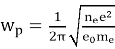

Radio Wave Frequency (ω): The frequency of the signal sent by the spacecraft. When

However, when
4. Parameters that influence blackout severity and density
Propagation of radio signals is strongly dependent on ionospheric electron density, which determines whether a transmitted signal will be absorbed in the D-region ionosphere, be reflected in the E or F-region ionosphere back toward the ground, or be transmitted entirely through the ionosphere [6].
The primary phenomena affecting high frequency communication (HF COM) are absorption and post-storm MUF depression (PSD).
HF signals are subject to absorption in the D-region ionosphere due to the interaction of radio waves with ionospheric particles. Energy from the radio waves is transferred to charged particles in the ionosphere and can be lost through collisions with neutral particles before being reradiated. The D-region ionosphere has a high neutral particle density compared to the upper E and F-regions of the ionosphere. This higher neutral particle density results in an increased rate of particle collisions, causing radio waves to be dispersed or absorbed, as heat, thereby reducing signal strength. Enhancements in the D-region electron density, often caused by space weather, lead to increased absorption. There are three primary types of absorption affecting HF COM: shortwave fadeout, auroral absorption, and polar cap absorption.
- Solar X-ray flares are a sudden brightening of the solar photosphere accompanied by an emission of electromagnetic radiation. The enhanced radiation increases photoionization on the sunlit side of the Earth, enhancing the electron density. A direct result is the increased absorption of shortwave radio signals, commonly referred to as shortwave fadeouts. Shortwave fadeout is characterized by a sudden reduction in the signal strength followed by a more gradual recovery and closely follows the timescales of the solar flare radiation.
- The D-region ionosphere is sensitive to the precipitation of high energy (>30 keV) magnetospheric electrons driven by the solar wind-magnetosphere–ionosphere interaction. This energetic electron precipitation can be intensified during space weather events leading to enhanced ionization in the ionosphere at auroral latitudes, causing a phenomenon known as auroral absorption.
- Solar energetic protons expelled at the same time as a solar flare or coronal mass ejection (CME) can be accelerated to near relativistic speeds, reaching the Earth within a few hours. The solar energetic protons penetrate down to D-region altitudes in the high-latitude region reaching as equatorward as 60–65° MLAT causing polar cap absorption (PCA). This form of absorption is more strongly felt in the high-latitude sunlit ionosphere leading to a solar zenith angle dependence on the level of absorption, with strongest impacts near local noon falling off toward the terminator.
Post storm maximum usable frequency depression (PSD)
The upper limit of the HF frequency window, described by the MUF, is dependent on the F region electron density profile. After the onset of a geomagnetic storm, F-region electron densities can reduce below quiet-time values (negative storm effect). Negative storm effects can last for several tens of hours and can cause difficulties for HF radio links operating at higher frequencies. Geomagnetic storms can also cause F region electron density enhancements (positive storm effect). Positive storm effects are not detrimental to HF systems.
5. Mitigation technics
Since some years ago, numerous techniques were in development to resolve the RF blackout cutoff difficulty to during earth’s atmospheric re-entry [7]. The recommended approaches are as follows:
– Aerodynamic shaping method known as remote antenna assemblies
– Raman scattering process (electromagnetic pump wave with high frequency)
– Injection of quenchants (liquid/gas injection)
– SMF windows (interaction of electromagnetic filed in the plasma sheath)
– Using space probe transceiver with upper frequency carrier
References:
- https://www.researchgate.net/publication/299409954_Aerodynamics_and_thermal_features_of_reentry_spacecraft_with_blunt_body_capsule
- https://www.grc.nasa.gov/www/BGH/hihyper.html
- https://www.grc.nasa.gov/www/k-12/VirtualAero/BottleRocket/airplane/shock.html
- https://www.colorado.edu/lab/ngpdl/research/hypersonics/radio-communications-blackout
- https://arc.aiaa.org/doi/10.2514/2.3678
- https://www.swsc-journal.org/articles/swsc/full_html/2022/01/swsc220003/swsc220003.html
- https://ntrs.nasa.gov/api/citations/19700008892/downloads/19700008892.pdf