1. Introduction
The organic fraction dominates municipal solid waste in urban Vietnam, creating both a disposal burden and a resource-recovery opportunity through composting. Aerobic composting converts biodegradable matter into a stable, humus-like product, and its performance depends on temperature, moisture, C/N ratio, particle size, aeration, and pH [1], with temperature and moisture the most critical, as they govern microbial activity, degradation rate, and pathogen inactivation. Pilot-scale trials that track these factors under real, variable conditions remain valuable for validating design assumptions before scale-up [7]. This study monitors temperature, moisture, pile volume, and leachate during a pilot-scale trial of shredded organic MSW, and relates their variation to finished compost quality.
2. Materials and Methods
2.1 Feedstock preparation and reactor
The organic fraction of MSW (vegetables, fruit, food residues) was manually sorted and shredded to 2–3 cm. Due to pre-drying during rain, initial moisture remained high (77.9 %, gravimetric method); initial C/N ratio was ~20:1 and bulk density 244 kg/m³, within the reported 180–300 kg/m³ range [1]. The feedstock was inoculated with 5 g of an effective-microorganism (EM) solution and loaded into a 200-L pilot reactor fitted with a central perforated aeration pipe, air blower, heating lamps, and a leachate outlet. The trial ran 23 days under ambient outdoor conditions.
2.2 Process monitoring and finished compost analysis
Temperature, moisture, pile height, and leachate volume were recorded daily; moisture was determined gravimetrically (105 °C, 2 h). At trial end, finished compost was analyzed for moisture and Escherichia coli, and for total organic carbon (TCVN 9294:2012 [2]), total nitrogen (TCVN 8557:2010 [3]), available phosphorus (TCVN 8559:2010 [4]), and available potassium (TCVN 8560:2010 [5]), compared against the thresholds of Circular No. 41/2014/TT-BTNMT [6].
3. Results and Discussion
3.1 Temperature and moisture profiles
The pile followed the classical phases of aerobic composting (Figure 1). During the first three days, temperature rose gradually from 21 °C to 45 °C. By day 4 it reached a peak of 64–65 °C, sustained for about two days — sufficient to inactivate pathogenic bacteria, viruses, and weed seeds [1]. Thermophilic conditions (>40 °C) persisted until around day 15, aided by reactor insulation and heating lamps, then cooled (34–36 °C) and stabilized at 35–36 °C by days 21–23, when the compost was harvested.
Moisture started high (77 %), dropped sharply to 45.7 % within a day, and held near this level for three more days — still above the 40 % threshold for microbial activity. Between days 8 and 15, moisture fell to 20–33 % during intense solar exposure; water was added manually to keep it above 40 %.
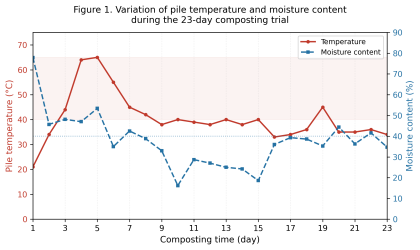
Fig. 1. Variation of pile temperature and moisture content over the 23-day composting trial
3.2 Leachate generation and pile volume reduction
Leachate generation peaked around day 12 and declined markedly thereafter, kept low overall by the effective insulation and covering of the reactor. Pile height fell by roughly 50 % within the first day, coinciding with the sharp initial moisture drop, and continued settling to an overall volume reduction of 70–78 % by day 23 — indicating substantial conversion of raw organic material into stabilized compost.
3.3 Quality of the finished compost
The finished compost met most reference thresholds set out in Circular No. 41/2014/TT-BTNMT [6]: total organic carbon reached 31.4 % (threshold ≥ 20 %), total nitrogen 3.98 %, and available K₂O 1.92 %. Available P₂O₅ (1.71 %) fell short, likely reflecting the naturally low phosphorus content of the winter–spring vegetable and fruit waste used as feedstock — a known limitation of seasonally variable feedstocks, typically addressed by supplementary blending with N-P-K amendments. No E. coli was detected, consistent with the sustained thermophilic temperatures (64–65 °C).
Table 1
Monitored process parameters and finished compost quality compared with reference values
|
Parameter |
Value / Result (this study) |
Reference Range / Threshold |
|
Process monitoring | ||
|
Initial moisture content |
77.9 % |
40–60 % [1] |
|
Initial C/N ratio |
~20:1 |
25–30:1 [1] |
|
Particle size |
2–3 cm |
< 5 cm (recommended) [1] |
|
Bulk density |
244 kg/m³ |
180–300 kg/m³ [1] |
|
Peak pile temperature |
64–65 °C (day 4–5) |
55–65 °C [1] |
|
Thermophilic duration (>40 °C) |
~15 days |
≥ 3 days (pathogen kill) [1] |
|
Finished compost quality | ||
|
Total organic carbon |
31.4 % |
≥ 20 % [6] |
|
Total nitrogen (N) |
3.98 % |
Meets requirement [6] |
|
Available P₂O₅ |
1.71 % |
Below requirement [6] |
|
Available K₂O |
1.92 % |
Meets requirement [6] |
|
E. coli |
Not detected |
Not detected (required) [6] |
4. Conclusion
Continuous monitoring of temperature, moisture, and pile volume was essential for managing this pilot-scale trial. The pile reached and sustained thermophilic temperatures sufficient for pathogen inactivation, while moisture required active correction — particularly water addition during strong solar exposure — to stay within the range needed for microbial activity. The 70–78 % volume reduction confirmed substantial organic matter degradation, and the compost met most quality thresholds except phosphorus, a limitation linked to the seasonal composition of the feedstock. These findings underline the value of close temperature and moisture monitoring, and timely corrective action, for the reliable operation of small-scale aerobic composting of organic MSW.
References:
- Dakshesh Chimanbhai Saypariya, Deval Singh, Anil Kumar Dikshit, Mohan B. Dangi (2024). Composting of organic fraction of municipal solid waste in a three-stage biodegradable composter. Heliyon, 10(17), e37444. https://doi.org/10.1016/j.heliyon.2024.e37444
- TCVN 9294:2012. Fertilizers — Determination of total organic carbon by the Walkley–Black method. Ministry of Science and Technology, Vietnam.
- TCVN 8557:2010. Fertilizers — Method for determination of total nitrogen content. Ministry of Science and Technology, Vietnam.
- TCVN 8559:2010. Fertilizers — Method for determination of available phosphorus content. Ministry of Science and Technology, Vietnam.
- TCVN 8560:2010. Fertilizers — Method for determination of available potassium content. Ministry of Science and Technology, Vietnam.
- Circular No. 41/2014/TT-BTNMT. Guiding the implementation of certain provisions of Decree No. 202/2013/ND-CP on fertilizer management. Ministry of Natural Resources and Environment, Vietnam, 2014.
- Stegenta-Dąbrowska S, Randerson PF, Białowiec A. (2022) Aerobic Biostabilization of the Organic Fraction of Municipal Solid Waste—Monitoring Hot and Cold Spots in the Reactor as a Novel Tool for Process Optimization. Materials . 15(9):3300. https://doi.org/10.3390/ma15093300