Introduction. Problemthe field of time-of-death diagnostics (TD) has been developed by many scientists worldwide for a century and a half. One of the main areas of research in this area is the study of postmortem phenomena occurring in organs, tissues and fluids [1].
There are a few reports in the literature on the role of nitrates/nitrites in determining injury duration. For example, researchers have found that in the myocardium, in the first 3 hours after injury, the level of inducible NO synthase changed only slightly. After 12 hours, a sharp decrease in the activity of this enzyme was noted [2].
The involvement of nitro derivatives of nitrogen (nitrate and nitrite derivatives) in many pathological processes has been established [6]. An important modulating role of NO has been demonstrated in the stress response, which includes many severe neurological (traumatic brain injury, acute cerebrovascular accidents, primarily acute cerebral ischemia) and somatic diseases (sepsis, shock, polytrauma). The stress response of the immunoneuroendocrine system is triggered by the activation of its main stress-realizing axes — the hypothalamic-pituitary-adrenal and sympathoadrenal axes. The stress response, which was initially adaptive, soon begins to participate in the mechanisms of the pathological process: excessive hormonal changes cause a complex of circulatory and metabolic disorders and close the vicious circles of the pathogenesis of a particular disease [4].
The study [5] described 19 cases of hospital death from septic shock in which patients exhibited apoptosis of neurons and microglial cells in the brain, as well as increased levels of inducible NO synthase and tumor necrosis factor. It was noted that NO can serve as a factor initiating the kinase breakdown of the main regulatory system that controls the expression of a number of genes responsible for the development of cell apoptosis [12].
Purpose of the study. To identify the relationship between TD and changes in the dynamics of nitrate/nitrite levels in the blood plasma of deceased people.
Material and methods. The level of nitrites/nitrates was determined in cadaveric blood plasma using a method based on the reduction of nitrates to nitrites with zinc dust in an alkaline medium in the presence of an ammonia complex of copper sulfate, followed by photometry [7]. Blood plasma from human cadavers was taken dynamically, 2–6, 7–11, 12–16 and 17–21 hours after death. Blood plasma taken from the right side of the heart and large vessels of cadavers of people who died from multiple injuries (20) and from ischemic heart disease (17) was analyzed. For deproteinization, 1 ml of 6 % zinc sulfate solution was added to 1 ml of plasma. The mixture was left for 1 hour at a temperature below 15°C. Centrifugation was carried out at 6000 rpm. After deproteinization, an equivalent amount of sodium hydroxide was added to 1 ml of the supernatant. Centrifugation was then repeated, and 1 ml of the supernatant was transferred to a correspondingly numbered plastic tube containing 0.11 g of zinc dust, 0.5 ml of ammonia buffer, and 20 ml of ammonium copper sulfate complex. The tubes were then shaken for 30 minutes. Zinc dust was precipitated by centrifugation at 3000 rpm for 10 minutes. From each plastic tube, 1 ml of supernatant was transferred to a correspondingly numbered glass tube. 1 ml of sulfanilic acid was added to each tube, and the tubes were left in the refrigerator for 10 minutes until the diazotization reaction was complete. Then, 1 ml of sodium acetate solution and 1 ml of 1-naphthylamine hydrochloride solution were added to each tube. The optical density was measured after 30 minutes at a wavelength of 520 nm. The concentration of nitrites/nitrates was calculated using the calibration curve equation, taking into account the dilution during deproteinization.
Statistical data processing was performed using the Pimer Biostatistics program. Since the distribution of the studied variables deviated from normality, the median, 25th, and 75th percentiles were used for descriptive statistical analysis. The Mann-Whitney U test was used to compare the significance of differences between groups. Differences were considered statistically significant at p < 0.05.
Research results. The study involved blood plasma collected dynamically from 28 human cadavers, including 20 men and 8 women.
Depending on the cause of death, two groups of deceased were identified.
The first group included individuals whose death occurred suddenly from coronary heart disease (CHD) — 17 cases (60.7 %). In all cases, ethyl alcohol was not detected in the blood of the corpses.
The second group included individuals who died from mechanical injuries — 11 cases (39.3 %). The causes of death were divided as follows: blunt trauma (2), closed craniocerebral trauma (2), and asphyxia due to hanging (3).
Blood was taken syringes at intervals, starting from the moment of collection, then after 4; 8; 14; 20 hours. In order to statistically process the obtained data, groups were formedat time intervals: 2–6; 7–11; 12–16; 17–21 hours based on plasma nitrate/nitrite levels.
The time interval during which death could have occurred was known from the preliminary investigation or inquiry materials, and was roughly determined based on the severity of cadaveric phenomena using methods generally accepted in expert practice (the state of cadaveric spots after insufficient pressure, rectal thermometry, the severity of rigor mortis). In some cases, the death of the deceased was confirmed by the ambulance team and in the medical records of the inpatient.
The comparison group included the corresponding indicators of nitrate/nitrite levels in the blood plasma of 15 practically healthy individuals (donors) of the Vitebsk Regional Blood Transfusion Station.
The methodological basis for this study was the methodology developed in the biochemistry laboratory of the Central Scientific Research Laboratory of the Vitebsk State Medical University. In this work, we utilized this method, which is widely used in medical practice for diagnostic purposes.
Neutrophils and macrophages are known to actively generate free oxygen radicals: superoxide anion radical, hydrogen peroxide, hydroxyl radical, and singlet oxygen. Like nitric oxide, these radicals possess an extra electron, which accounts for their high chemical reactivity. Leukocytes are the source of NO in blood plasma. The accumulation of nitrates/nitrites after death may indicate their degradation. Numerous experiments have confirmed that phagocytes (macrophages, neutrophils) are capable of synthesizing NO synthase and releasing relatively large quantities of the gas. Macrophage NO synthase, in turn, is an inducible enzyme. Under normal conditions, cells lack this enzyme and do not produce NO. NO formation in the human body occurs through the oxidation of the nitrogen atom found in the amino acid L-arginine, under the action of three isoenzymes — NO synthases.
The chosen method for determining NO levels is new and untested in forensic medicine, including for determining the TD. Based on the above, the aim of our study was to investigate the dynamics of nitrate/nitrite levels in the postmortem period.
Due to the fact that the NO molecule is short-lived and has not been studied in the postmortem period, the task was set-to study the change in the level of nitrates/nitrites in the blood plasma of corpses who died from coronary heart disease and mechanical injuries depending on the TD.
The results of the study are presented in Table 1.
Table 1
Addiction nitrate/nitrite levels in the blood plasma from the TD of those who died from CHD and mechanical injuries
|
Cause of death |
Time elapsed since death (hours) | |||
|
2–6 |
7–11 |
12–16 |
17–21 | |
|
CHD (n=17) |
61.5 (59–66) |
35(31–38)** |
9(6–12)*** |
- |
|
Mechanical injuries (n=11) |
- |
28(27–30) |
16(14–9)** |
5(3–8)*** |
|
Control group (n=15) |
22 (20.48–28.5) µmol/l | |||
Note – * - p<0.05, ** — p<0.01, *** — p<0.001
When assessing the kinetics of nitrite/nitrate levels reflecting nitrosative stress, after 2–6 hours in the first group of deceased from CHD (n=17), the nitrate/nitrite level was 61.5 (59; 66) μmol/l, which was much higher than in the control group of donors — 22 (20.48; 28.5) μmol/l. Then, the indicators decreased after 9–11 hours and amounted to 35 (31; 38) μmol/l (p<0.01), and after 12–16 hours there was a sharp decrease in the indicator to 9 (6; 12) μmol/l (p<0.001).
When assessing the dynamics of nitrate/nitrite levels reflecting nitrosative stress, it was found that after 7–11 hours in the second group of those who died from mechanical injuries (n = 11), the median (interquartile range) nitrate/nitrite level was 28 (27; 30) μmol/l. This turned out to be significantly higher compared to the control group of donors — 22 (20.5; 28.5) μmol/l. But 12–16 hours after death, the level of nitrates/nitrites in the plasma was lower and amounted to 16 (14; 19) μmol/l (p < 0.01), and after 17–21 hours it decreased to 5 (3; 8) μmol/l (p < 0.001).
Analyzing the obtained data, it can be noted that nitrate/nitrite levels in the blood plasma of those who died from CHD and mechanical injuries increased sharply between 2 and 6 hours after death. Then, starting 7 hours after death, these levels decreased significantly and reached zero by the end of the day (Figure 1).
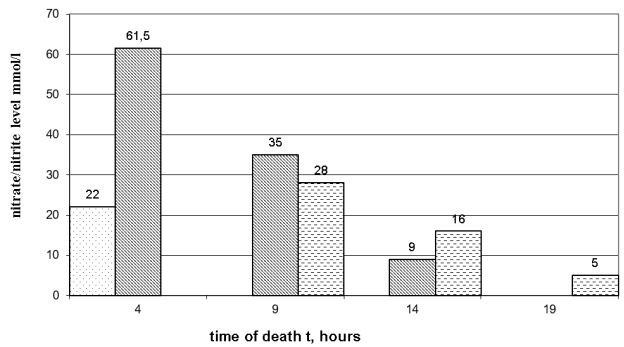
Fig. 1. Addiction nitrate/nitrite levels in blood plasma from TD in deceased from coronary heart disease and mechanical injuries
A regression analysis of the obtained data was carried out using the Statgraphics 18.1.16 program.
Taking into account the nitrate/nitrite levels, the TD can be determined using the obtained equation (1):
t=21.1–0.4345*a, (1)
where t is the TD; a is the level of nitrates/nitrites in the blood plasma.
The construction was carried out in a linear regression relationship. Correlation coefficient = -0.9996; p<0.001.
Let's give an example. A 29-year-old woman died from blunt force trauma following a fall from a height. Blood was tested 12 hours after death. The nitrate/nitrite level was determined to be 16.25 μmol/l. Using the plasma nitrate/nitrite relationship equation, we determine that 14 hours had passed since death.
For ease of use of the method, one of the graphs of the dependence of the level of nitrates/nitrites in plasma on the TD in those who died as a result of coronary heart disease and mechanical injuries can be used (Figure 2).
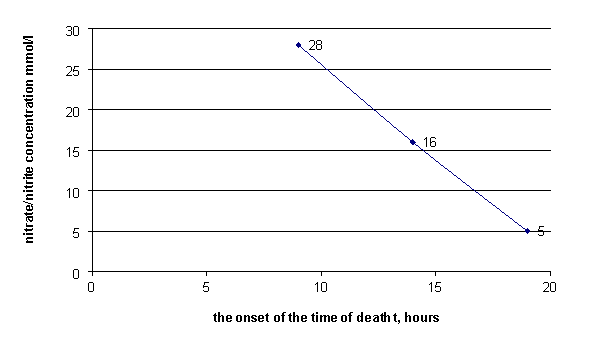
Fig. 2. The dependence of nitrate/nitrite levels in blood plasma on the TD in patients who died as a result of mechanical injuries
Let's give an example. A 29-year-old woman died from blunt force trauma following a fall from a height. Blood was analyzed 12 hours after death. The nitrate/nitrite level was determined to be 16.25 μmol/l. Using the plasma nitrate/nitrite curve, we determine that 14 hours have passed since death. This time of death corresponds to the time obtained when determining the value in the regression equation.
Conclusion. Thus, the obtained data on plasma nitrate/nitrite levels can be used as a diagnostic criterion for establishing CHD within 24 hours of death. The sharp increase in plasma nitrate/nitrite levels in the first hours after death is likely explained by changes in vascular endothelial permeability under the influence of prionflammatory cytokines (TNF-α, IL-6, etc.) and microbial lipopolysaccharides, followed by the formation of an inducible form of NO synthase.
References:
- Naumenko V. G. Current state and prospects for solving the problem of diagnosing the time since death / V. G. Naumenko // Forensic medical examination. — 1984. — No 2 — P. 9–12.
- Solyaniy A. N. Possibility of forensic determination of the age of damage by changes in the NO synthase enzyme in the myocardium. Ukrain. morf. alm. — 2008. — No 11(4) — P. 143–144.
- Anggard E. Nitric oxide: mediator, murderer, and medicine. The Lancet. — 1994. — No 14 (343) — P. 1199–1206.
- Golikov P. P., Nikolaeva N.Yu., Gavrilenko I. A. Nitric oxide and lipid peroxidation as factors of endogenous intoxication in emergency conditions. Pat. physiology and experimental therapy. — 2000. — No 2 — P. 6–9.
- Sharshar T., Margentaler J.A, Landeros K. Apoptosis of neurons in cardiovascular autonomic centers triggered by inducible nitric oxide synthase after death from septic shock. The Lancet. — 2003. — No 362 (9398) — P. 1799–1805.
- Dwivedi Y., Rizavi H.S, Roberts R.C, Conley R.C, Tammings C.A, Pandey G.N Reduced activation an expression of ERK ½ MAP kinases in the post-mortem brain of depressed suicide subjects. Journal of Neurochemistry. — 2001 — No 77 (3) — P. 916–928.
- Solodkov A. P., Veremey I. S., Osochuk S. S., Shcherbinin I.Yu., Deyun G. V., Dubrovskaya A. V. Photometric method for determination of nitrates and nitrites in biological fluids: instructions for use. Approved. Ministry of Health of the Republic of Belarus, No 91–0008 dated 19.03.2001.
- Ramesh S.S., Prasanthi A., Bhat D.I., Devi B.I., Christopher R., Philip M. Correlation between plasma total nitric oxide levels and cerebral vasospasm and clinical outcome in patients with aneurysmal subarachnoid hemorrhage in Indian population. J. Neurosci. Rural. Pract. — 2014. — № 5 (1) — P. 25–27.
- Ma L., Hu L., Feng X., Wang S. Nitrate and nitrite in health and disease. — Aging Dis. — 2018. — No 9 — P. 938–945.
- Jackson J., Patterson A.J., McDonald-Weeks L., McEvoy M. The role of inorganic nitrates and nitrites in the development of cardiovascular diseases. Nutr Res Rev. — 2017. — No 30 — P. 247–264.
- Ma L., Hu L., Feng X., Wang S. Nitrate and nitrite in health and disease. Aging Dis. — 2018. — No 9 — P. 938–945.
- Reduced activation an expression of ERK ½ MAP kinases in the post-mortem brain of depressed suicide subjects / Y. Dwivedi [et al.] // Journal of Neurochemistry. — 2001. — Vol. 77 (3) — P. 916–928.