Грязевые вулканы северной части Бакинского архипелага являются важными геологическими и геохимическими индикаторами миграции глубинных флюидов и нефтегазового потенциала Южно-Каспийского бассейна. В исследовании синтезированы доступные данные о продуктах извержений, включая грязь, воду, газ и минерализованные выбросы со следами нефти, с целью оценки их химических и минералогических свойств. Воды разных вулканов показывают широкий диапазон минерализации — от типов Na–HCO₃ и Na₂SO₄ до рассолов CaCl₂ и MgCl₂, что отражает вклад источников разной глубины. Минералогический анализ выявил сульфиды, фосфаты, оксиды и металлические микросферы, указывая на активное взаимодействие флюидов с породой и перенос металлов из глубоких слоев. Понимание этих геохимических характеристик помогает оценить активность грязевых вулканов, пути миграции подземных флюидов и потенциальные нефтегазовые залежи региона.
Ключевые слова: грязевой вулкан, геохимия, продукты извержений, Бакинский архипелаг, Южно-Каспийский бассейн, флюиды, минералы, нефть.
Introduction
Mud volcanoes represent one of the most distinctive surface expressions of deep fluid, gas, and sediment migration within rapidly subsiding sedimentary basins. They act as natural conduits through which fluids, gases, and solid materials originating from different stratigraphic levels are transported to the surface, preserving valuable geochemical information about subsurface processes and petroleum systems [7]. The South Caspian Basin, and particularly the Baku Archipelago, hosts one of the world’s highest concentrations of active onshore and offshore mud volcanoes, making this region a key natural laboratory for studying mud volcanism and its geochemical manifestations [4].
Previous studies have demonstrated that eruption products of mud volcanoes—including mud breccia, fluids, gases, and authigenic minerals—record complex interactions between water, rock, and hydrocarbons under conditions of elevated pressure and temperature at depth. Geochemical analyses of mud volcano fluids and gases from Azerbaijan indicate a predominance of Na–Cl type waters, thermogenic methane, and minor heavier hydrocarbons, reflecting deep sedimentary and petroleum system sources [3, 9]. Isotopic and chemical data further suggest that these fluids may originate from depths ranging from several kilometers to more than 10 km, depending on the tectonic and thermal structure of the basin [4, 10].
Recent mineralogical and geochemical investigations have emphasized the importance of fluid–rock–gas reactions occurring within shallow mud chambers prior to eruption. Studies from the Caspian Sea region show that mud volcano ejecta commonly contain altered clay minerals, carbonates, sulfides, and Fe–Mn phases formed through interaction between ascending fluids and host sediments [1, 2]. Similar processes have been documented at the Zenbil island mud volcano, where fluidogenous mineralization reflects changing redox conditions, hydrocarbon oxidation, and metal mobilization during fluid ascent [11].
Despite the substantial body of work on mud volcanoes in Azerbaijan, most geochemical studies have focused either on individual volcanoes or on broad regional trends without systematic synthesis of eruption products specific to the northern part of the Baku Archipelago. In particular, variations in the geochemical composition of solid ejecta, fluids, and gases between different mud volcanoes within this offshore–nearshore transition zone remain insufficiently summarized and compared using published datasets [1, 9]. Moreover, the relationship between geochemical signatures of eruption products and the geological setting of the Productive Series and deeper Mesozoic sediments has not been fully integrated in a single interpretative framework [5, 12].
Understanding the geochemical properties of mud volcano eruption products in the northern Baku Archipelago is important not only for advancing knowledge of mud volcanism but also for evaluating hydrocarbon generation, migration pathways, and deep fluid circulation within the South Caspian Basin. Mud volcano geochemistry has proven to be a valuable indirect tool for assessing oil and gas potential, thermal regime, and overpressure conditions in deeply buried sedimentary successions [4, 6, 7].
The main aim of this study is to synthesize and interpret published geochemical data on the eruption products of mud volcanoes in the northern part of the Baku Archipelago, with particular emphasis on fluid composition, gas geochemistry, mineralogical features, and fluid–rock interaction processes. By integrating results from previous studies, this work seeks to identify common geochemical patterns, regional characteristics, and existing data gaps, thereby providing a consolidated reference framework for future geological and geochemical investigations in the South Caspian mud volcanic province.
Data and Methods
The main dataset includes chemical analyses of mud volcano waters (major ions, mineralization degree, water type), gas geochemistry (methane dominance, isotopic composition of carbon and hydrogen, presence of higher hydrocarbons and CO₂), and mineralogical–geochemical characteristics of solid ejecta such as breccia, clay matrix and authigenic mineral phases [2, 9, 11].
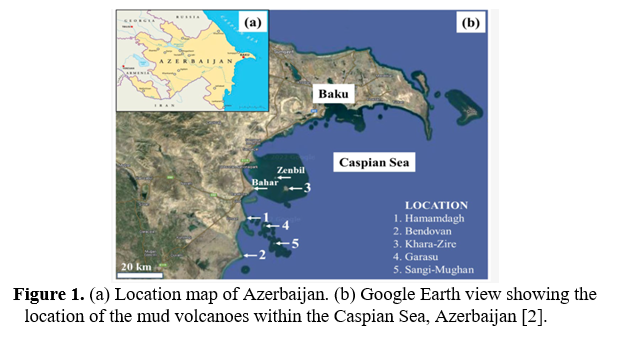
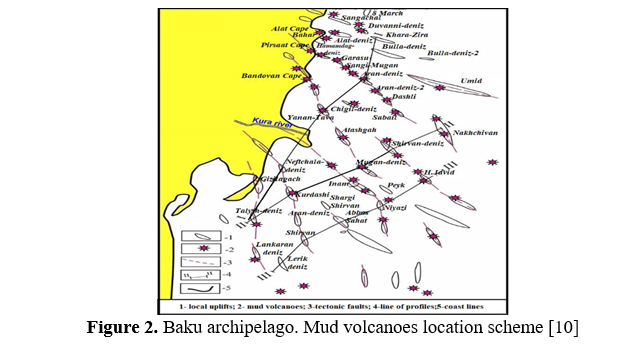
According to water-geochemistry data, mud volcano waters of the Baku archipelago are characterized by a wide range of mineralization values, reflecting different depths and sources of fluid generation. Reported mineralization values vary from relatively low mineralization in some island volcanoes to very high mineralization in others, indicating strong heterogeneity in fluid sources and migration pathways [2, 4]. For example, comparative analysis of water samples shows that mineralization generally increases from the north-west towards the south-east and south directions of the archipelago (Figure 1, 2), which corresponds to basin deepening and increasing burial depth of sedimentary sequences [4, 10].
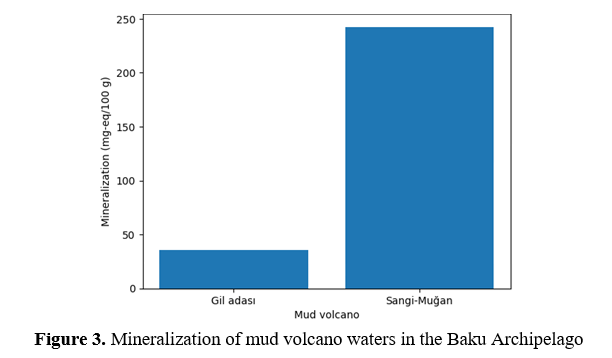
The compiled data indicate significant variability in the geochemical composition of waters discharged by mud volcanoes of the northern Baku Archipelago. The lowest mineralization values are characteristic of Gil adasi, 35.7 mg-eq/100 g, where waters are dominated by Na–HCO₃ composition and likely originate from relatively shallow sedimentary levels. In contrast, Sangi-Mugan exhibits the highest degree of mineralization, reaching values above 242.5 mg-eq/100 g, with CaCl₂–MgCl₂ type waters, suggesting contribution from deeper, more evolved brines (Figure 3).
Mud volcanoes such as Zenbil and Dashgil show intermediate mineralization levels and are dominated by Na–Cl type waters, which are typical for deep basinal fluids in the South Caspian Basin. These waters are commonly associated with hydrocarbon-bearing strata and active fluid–rock interactions, including metal transport and mineral precipitation. The observed variability supports the concept that mud volcanoes in the Baku Archipelago are fed by fluids originating from multiple depth intervals and geological environments, rather than a single uniform source [2, 9, 11].
The chemical type of mud volcano waters also varies systematically across the region. In relatively shallow or marginal areas, alkaline water types such as NaHCO₃ and Na₂SO₄ dominate, whereas in deeper and more mature parts of the basin these waters are progressively replaced by CaCl₂ and MgCl₂ types [2, 4]. This transition reflects ongoing water–rock interaction processes, including ion exchange, clay mineral transformation and dissolution–precipitation reactions during deep burial and fluid ascent. Similar geochemical evolution trends have been documented for other South Caspian mud volcanoes and are consistent with models of progressive fluid maturation with depth [1, 2].
Gas geochemistry data indicate that methane is the dominant component of gases emitted by mud volcanoes of the Baku archipelago, with isotopic signatures mainly corresponding to thermogenic origin, although admixture of microbial methane is also reported in some cases [3, 8, 9]. The presence of higher hydrocarbons and CO₂ further supports a deep sedimentary source for gases, often related to oil and gas-generating intervals within the Productive Series and deeper Mesozoic sequences [8, 9, 10]. Variations in gas composition and isotopic ratios between different volcanoes suggest differences in source depth, thermal maturity and migration pathways.
Mineralogical and geochemical data of solid eruption products provide additional evidence for complex fluid–rock interactions in mud volcano systems. Studies of the Zenbil mud volcano reveal the presence of fluidogenic mineralization, including native metals, metal alloys, sulfides, oxides and phosphate minerals within the breccia material [11]. These mineral phases are interpreted as products of deep, metal-bearing fluids ascending together with mud and sediments, rather than simple mechanical entrainment of host rocks.
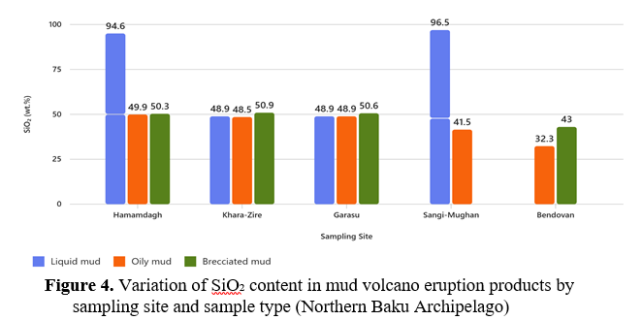
In addition to mineral phases, the bulk chemical composition of solid ejecta demonstrates significant variability in silica content across different mud types and sampling sites (Figure 4). Brecciated mud generally exhibits the highest SiO₂ concentrations, exceeding 50 wt. % at Khara-Zire and Garasu, while liquid mud samples maintain relatively high values around 48–49 wt. %. Oily mud shows greater heterogeneity, with Bendovan displaying a marked decrease to 32.3 wt. % compared to other sites [2]. These differences highlight the influence of geological conditions and eruption dynamics on the geochemical composition of mud volcano products in the northern Baku Archipelago. Understanding these variations is crucial because SiO₂ content directly reflects the mineralogical maturity (high SiO₂ values typically correspond to a greater proportion of quartz and other silica-rich minerals, which are stable and resistant to alteration) and sedimentary source characteristics of the erupted material, which in turn provides insights into the depth of origin, fluid–rock interaction processes, and tectonic setting of mud volcano systems [2].
Similar conclusions are supported by detailed mineralogical and geochemical investigations of Bahar and Zenbil volcanoes, which demonstrate significant alteration of clay minerals and precipitation of authigenic phases during fluid ascent [1].
By synthesizing these datasets, it becomes evident that mud volcanoes of the northern Baku archipelago represent integrated systems linking deep hydrocarbon-generating strata, fluid-rock interaction zones and surface eruption products. The variability observed in water mineralization, water type, gas composition and solid ejecta mineralogy reflects differences in structural position, depth of feeding horizons and thermal regime across the archipelago [2, 4, 10]. At the same time, inconsistencies and gaps in available datasets — especially for offshore and island volcanoes — indicate that the geochemical diversity of eruption products is still not fully documented.
Thus, the compiled data allow not only a descriptive characterization of the geochemical properties of mud volcano eruption products, but also a comparative evaluation of fluid sources, migration processes and interaction mechanisms controlling mud volcanism in the northern part of the Baku archipelago.
Conclusion
The synthesis of published geochemical, mineralogical and gas-geochemical data shows that eruption products of mud volcanoes in the northern part of the Baku archipelago record complex interactions between deep fluids, sediments and gases within the South Caspian Basin. Variations in water mineralization, ionic composition, gas origin and solid ejecta mineralogy reflect differences in source depth, structural position and fluid migration pathways, with a general increase in mineralization and chloride dominance toward deeper and more subsiding parts of the basin. The presence of thermogenic methane, isotopic signatures of deep hydrocarbons, and fluid-induced mineral phases such as metal oxides, sulfides and phosphates indicates that mud volcanoes act as efficient conduits for deep-seated fluids and materials. Overall, the reviewed data confirm that mud volcanoes of the Baku archipelago are not only surface expressions of overpressure but also important geochemical indicators of subsurface petroleum systems and fluid–rock interaction processes in the South Caspian Basin.
References:
- Baldermann, A., Abbasov, O. R., Bayramova, A., Abdullayev, E., Dietzel, M. (2020). New insights into fluid-rock interaction mechanisms at mud volcanoes: Implications for fluid origin and mud provenance at Bahar and Zenbil (Azerbaijan). Chemical Geology, 537, 119479. https://doi.org/10.1016/j.chemgeo.2020.119479
- Bayramova, A., Abbasov, O. R., Aliyev, A. A., Baloglanov, E. E., Stamm, F. M., Dietzel, M., & Baldermann, A. (2023). Tracing Water–Rock–Gas Reactions in Shallow Productive Mud Chambers of Active Mud Volcanoes in the Caspian Sea Region (Azerbaijan). Minerals, 13(5), 696. https://doi.org/10.3390/min13050696
- Bonini, M., Tassi, F., Feyzullayev, A. A., Aliyev, C. S., Capecchiacci, F., & Minissale, A. (2013). Deep gases discharged from mud volcanoes of Azerbaijan: New geochemical evidence. Marine and Petroleum Geology, 43, 450–463. https://doi.org/10.1016/j.marpetgeo.2012.12.003
- Feyzullayev, A. (2012). Mud volcanoes in the South Caspian basin: Nature and estimated depth of its products. Natural Science, 4, 445–453. https://doi.org/10.4236/ns.2012.47060
- Hinds, D. J., Aliyeva, E., Allen, M. B., Davies, C. E., Kroonenberg, S. B., Simmons, M. D., & Vincent, S. J. (2004). Sedimentation in a discharge dominated fluvial-lacustrine system: the Neogene Productive Series of the South Caspian Basin, Azerbaijan. Marine and Petroleum Geology, 21(5), 613–638. https://doi.org/10.1016/j.marpetgeo.2004.01.009
- Huseynova, A. B. (2019). Isotopic Geochemistry of Mud Volcano Fluids. Reports of ANAS, 75(1). Azerbaijan National Academy of Sciences.
- Kopf, A. J. (2002). Significance of mud volcanism. Reviews of Geophysics, 40(2), 1005. https://doi.org/10.1029/2000RG000093
- Lin, Y.-T., Rumble, D., Young, E. D., Labidi, J., Tu, T.-H., Chen, J.-N., et al. (2023). Diverse origins of gases from mud volcanoes and seeps in tectonically fragmented terrane. Geochemistry, Geophysics, Geosystems, 24, e2022GC010791. https://doi.org/10.1029/2022GC010791
- Mazzini, A., Svensen, H., Planke, S., Guliyev, I., Akhmanov, G. G., Fallik, T., & Banks, D. (2009). When mud volcanoes sleep: Insight from seep geochemistry at the Dashgil mud volcano, Azerbaijan. Marine and Petroleum Geology, 26(9), 1704–1715. https://doi.org/10.1016/j.marpetgeo.2008.11.003
- Mukhtarova, K., Nasibova, G., & Zeynalova, S. (2024). Relationship of oil and gas prospects and temperature distribution with depth to mud volcanism in Baku Archipelago. Proceedings of Azerbaijan Higher Technical Educational Institutions, 26(5), 6–12. https://doi.org/10.36962/PAHTEI149052024–06
- Shnyukov, Ye. F., Aliev, Ad. A., Ivanchenko, V. V., Agaev, A. M., & Permyakov, V. V. (2019). Fluidogenous mineralization of the mud volcano of Zenbil (Duvannyi) island in the Caspian Sea. Geology and Mineral Resources of World Ocean, 15, 25–41. https://doi.org/10.15407/gpimo2019.03.025
- Zeynalova, S., Manyuk, V., Karimzade, F., Shahbazov, R., & Zahidova, T. (2024). Substantiating of oil and gas prospects of Mesozoic sediments based on the geochemical model of mud volcanoes in the Shamakhi-Gobustan structural element of the South Caspian megadepression. Journal of Geology, Geography and Geoecology, 33, 617–629. https://doi.org/10.15421/112457