1. Introduction
We consider numerical solving the hyperbolic equation
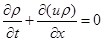
equipped with suitable initial and boundary conditions for known velocity coefficient 
Among the successful numerical methods for solving this equation we mention such nonoscillatory conservative finite difference shemes as TVD (total variation diminishing), TVB (total variation bounded), ENO (essentially nonoscillatory), and CABARET (Compact Accurate Boundary Adjusting high REsolution Technique) shemes (see [1]- [11] and the reference there). This approach uses the traditional difference approximation of temporal derivative and is liable to Courant — Friedrichs — Lewy (CFL) condition for ratio between steps in time and space.
The other approach focuses on the approximation of the whole operator of problem (1) as the partial derivative in some direction of the space  This approach is developed under different names: methods of trajectories or modified characteristics and semi-Lagrangian one (see, for example, [12]- [19] and the reference there).
In order to highlight the essential ingredients of suggested approach we shall operate with one-dimensional problem again, keeping in mind that we shall extend this method in subsequent papers. In this paper, we will first show how to consider the possible boundary conditions in contrast to the periodic conditions of the previous paper [16]. Then we modify the presented algorithm for big and huge velocity and give a numerical example that demonstrates the stability independent of CFL condition.
2. The statement of problem and the main theorem
So, in the rectangle  consider equation
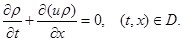 (1)
(1)
Assume that coefficient  is given at
  and is positive for simplicity sake.
Unknown function  satisfies the initial condition
 (2)
(2)
and boundary condition
 (3)
(3)
Assuming the continuity of  at we get
 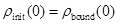 at the coordinate origin. Moreover, for continuity of first partial derivatives in (1) the following equality must hold:

By simple calculations we can obtain the necessary condition for the continuity of the second partial derivatives at the point (0, 0), etc. We will not dwell on the question of the sufficiency of this conditions for the smoothness of the solution  and at once we assume sufficient smoothness of the velocity
  and solution for further considerations.
Let us take two time lines  with
with 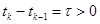 and two nodes
For both these nodes we construct the characteristics  of equation (1) at segment
  [20, 21]. They satisfy the ordinary differential equation with different initial values:
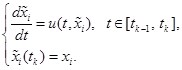 (4)
(4)
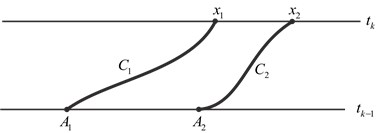
Fig. 1. Trajectories in standard (first) situation
These characteristics define two trajectories  in plane
  when
when  The typical situation is considered in the previous paper [20] when each of these trajectories crosses line
  in some point
  We supposed that they are not mutually crossed and therefore
  For this case the following result was proved in [16].
Theorem 1. For smooth solution of equation (1) in the standard (first) situation (Fig. 1) we have equality
 (5)
(5)
But the boundary condition (3) may produce two other situations. First, for small  the trajectory
  may be interrupted at line
  at point
  because function is unknown for
  But trajectory
  continues up to line
  (see Fig. 2). And second, both trajectories and are interrupted at line at points and
  (see Fig. 3). We enumerate these situations from one to three.
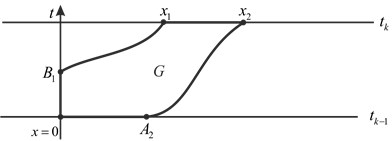
Fig. 2. Second situation: trajectory C1 is interrupted and C2 does not
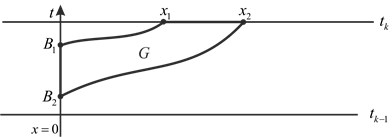
Fig. 3. Third situation: both trajectories C1 and C2 are interrupted
For last situations we prove two equalities.
Theorem 2. For smooth solution of equation (1) with boundary condition (3) in the second situation (Fig. 2) we get the equality
 (6)
(6)
Proof. Define by  the curvilinear pentagon bounded by lines
  And define by
  the corresponding parts of these lines, which form the boundary
  (see Fig. 4). Introduce also the external normal
  defined at each part of boundary except 5 vertices of pentagon.
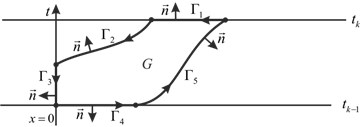
Fig. 4. Integration along the boundary in second case
Now use formula by Gauss-Ostrogradskii [20, 21] in the following form:
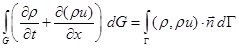 (7)
(7)
where sing  means scalar product. Since the boundary
  consists of five parts we calculate the integral over separately on each line:
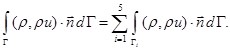 (8)
(8)
Along the line  the external normal equals
  Then
Then
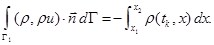 (9)
(9)
At arbitrary point  the tangent vector is
  Therefore the external normal (that is orthogonal to it) equals
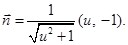 (10)
(10)
It implies equality
 (11)
(11)
Along the line  the external normal equals
  Then
Then
 (12)
(12)
For other two parts of the boundary we use the same way to calculate the integrals:
 (13)
(13)
 (14)
(14)
Combination of (7) — (9) and (11) — (14) implies (6):
 ?
?
The next result is justificated like previous theorem with some simplification. Therefore we give it without any proof.
Theorem 3. For smooth solution of equation (1) with boundary condition (3) in the third situation (Fig. 3) we get the equality
 (15)
(15)
Note that this situation contains the case when  and coincides with
So, consideration of the boundary conditions in the calculation expressions  resulted in an additional calculation of the integrals along
  of known function
  In this sense, consideration of boundary conditions makes minor modifications into the algorithms discussed below, so in further considerations we return to the periodic case.
3. Piece-wise linear discrete approximation
So, let the condition of periodicity holds for the problem (1) — (2), namely functions  are supposed periodical in
  with period
  and are smooth enough for further considerations.
Now we formulate some modification of numerical algorithm from [16] for solving problem (1) — (2). First, take integer  and construct uniform mesh in
  with nodes
  and meshsize
  Than take integer
  and construct uniform mesh in with nodes
  and meshsize
  Then make the following cycle for
 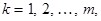 supposing that the approximate solution
  is known yet at previous time-level for
1. With the help of values in these points and periodicity we construct the piecewise linear (periodical) interpolant
 (16)
(16)
2. For each point  construct approximate trajectories
  down to time-level
  for example, by Runge-Kutta method. They produce cross-points
  If
If  goes outside segment
  we use periodicity of our data. One can see that we get values which do not coincide with exact values
  Let we solve equations (4) with the following accuracy:
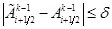 (17)
(17)
where  is small enough.
3. For each interval  compute integral
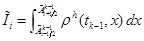 (18)
(18)
by trapezoid quadrature formula separately at each nonempty subinterval  where
where  is linear.
4. Due to Theorem 1 it is supposed that
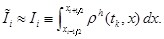 (19)
(19)
Finally we put
 (20)
(20)
Thus, we complete our cycle which may be repeated up to last time-level 
Condensed form of this algorithm in terms of piecewise linear periodical interpolants is written as follows:
 (21)
(21)
So, we get approximate discrete solution  at each time-level
 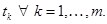 First we prove the conservation law in discrete form.
Let a discrete function  is given, and we construct piecewise linear interpolant
  with period 1.
Theorem 4. For any initial condition the approximate solution (16) — (20)  satisfies the equality:
 (22)
(22)
Proof. The justification directly coincides with the proof of Theorem 2 in [16] with substitution instead of
It is interesting that this discrete conservation law is exactly valid for an approximate values 
Now we prove a stability of algorithm (17) — (20) in the discrete norm analogous to that of space 
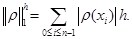 (23)
(23)
Theorem 5. For any intermediate discrete function  the solution
  of (17) — (20) satisfies the inequality:
 (24)
(24)
Proof. Again the justification directly coincides with the proof of Theorem 3 in [16] with substitution instead of
Now evaluate an error of approximate solution in introduced discrete norm.
Theorem 4. For sufficiently smooth solution of problem (1) — (2) we have the following estimate for the constructed approximate solution:
 (25)
(25)
with a constant  independent of
Proof. We prove this inequality by induction in  For
For  this inequality is valid because of exact initial condition (2):
  Suppose that estimate (25) is valid for some
  and prove it for
So, at time-level  we have decomposition
 (26)
(26)
with a discrete function  that satisfies the estimate
 (27)
(27)
Because of Taylor series in of  in the vicinity of point
  we get equality
 (28)
(28)
Because of Theorem 1

Instead of  let use its piecewise linear periodical interpolant
  Then
Then
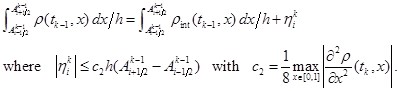 (29)
(29)
Thus, we get equality
 (30)
(30)
For  we use (21) and (26):
 (31)
(31)
where values of  are constructed by piecewise linear periodical interpolation.
Now let us evaluate the difference caused by error (17):

From the properties of piecewise linear interpolant it follows that

Therefore
 (32)
(32)
Now let subtract (31) from (30), multiply its modulus by  use (32), and sum for all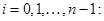
 (33)
(33)
Due to Theorem 3 last term in brackets is combined into  Thus
Thus
 (34)
(34)
Let put 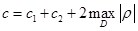 then this inequality is transformed with the help (27):

that is equivalent to (27).
We can see that at last time level we get inequality
 (35)
(35)
In some sense we got a restriction on temporal meshsize  to get convergence. For example, to get first order of convergence, it is enough to take

with any constant  independent of
  But this restriction is not such strong for constant as CFL condition:
 (37)
(37)
Moreover, it is opposite in meaning: here the greater  the better accuracy.
Thus, this approach is convenient for the problems with huge velocity which come from a computational aerodynamics: we have computational stability on the base of Theorem 4 and conservation law on the base of Theorem 3.
Now discuss the choice of  in (17). From (35) the better choice is
  i.e.,
i.e.,  For this purpose the standard Runge-Kutta method is acceptable that gives
  with appropriate accuracy and stability conditions [22, 23].
4. Numerical experiment
Let take and solve the equation (1) with initial condition

subject to periodicity. Then exact solution is

The result of implementing the presented algorithm is given in Table 1. Here in this experiment we set  (as the most implemented ratio in computations). The first line shows a number n of mesh nodes and the middle line contains the values
 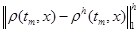 at last time level
  The last line demonstrates the order of accuracy.
Table 1
|
n |
40 |
80 |
160 |
320 |
640 |
1280 |
|
Error |
0.01228 |
0.00712 |
0.00194 |
0.00064 |
0.00026 |
0.00013 |
|
Order of accuracy |
1.341834 |
1.876304 |
1.192391 |
1.971816 |
1.017456 |
Thus we indeed have at least the first order of accuracy on h when  / h is fixed.
5. Conclusion
Thus, we continue presentation of the numerical approach [16] which is more convenient for huge velocity Here we show the treatment with boundary condition instead of periodical one, and then we examine theoretically and by numerical example the effect of the approximate solving the characteristics equations instead of exact process.
Again we have to note that the accuracy is the higher the less time steps done in the algorithm. But for the equations with nonzero right-hand side a small time step  will be crucial for appropriate approximation.
References:
1. Harten A., Osher S.: Uniformly high-order accurate non-oscillatory schemes // I. SIAM J. Numer. Anal. — 1987. — V. 24. — P. 279–309.
2. Harten A., Engquist B., Osher S., Chakravarthy S.: Uniformly high-order accurate non-oscillatory schemes, III // J. Comput. Phys. — 1987. — V. 71. — P. 231–303.
3. Osher S., Tadmor E.: On the convergence of different approximations to scalar conservation laws // Math. Comput. — 1988. — V. 50. — P. 19–51.
4. Sanders R.: A third-order accurate variation nonexpansive difference schem for single nonlinear conservation laws // Math. Comput. — 1988. — V. 51. — P. 535–558.
5. Чирков Д. В., Черный С. Г.: Сравнение точности и сходимости некоторых TVD-схем // Вычислительные технологии. — 2000. — Т. 5, № 5. — С. 86–107.
6. Cockburn B., Shu C.-W.: TVB Runge-Kutta projection discontinuous Galerkin finite element method for conservation laws II: general framework // Math. Comput. — 1988. — V. 52. — P. 411–435.
7. Shu C.-W.: TVB boundary treatment for numerical solution of conservation laws // Math. Comput. — 1987. — V. 49. — P. 123–134.
8. Shu C.-W.: Total-Variation-Diminishing time discretizations // SIAM J. Sci. Statist. Comput. — 1988. — V. 9. — P. 1073–1084.
9. Shu C.-W., Osher S.: Efficient implementation of essentially non-oscillatory shock-capturing schemes // J. Comput. Phys. — 1988. — V. 77. — P. 439–471.
10. Sweby P.: High-resolution schemes using flux limiters for hyperbolic conservation laws // SIAM J. Numer. Anal. — 1984. — V. 21. — P. 995–1011.
11. Головизнин В. М., Зайцев М. А., Карабасов С. А., Короткин И. А. Новые алгоритмы вычислительной гидродинамики для многопроцессорных вычислительных комплексов. — Москва: МГУ. — 2013.
12. Priestley A. A quasi-conservative version of the semi-Lagrangian advection scheme // Mon. Weather Rev. — 1993. — V. 121. — P. 621–629.
13. Scroggs J. S., Semazzi F. H. M. Aconservative semi-Lagrangian method for multidimensional fluid dynamics applications // Numer. Meth. Part. Diff. Eq. — 1995. — V. 11. — P. 445–452.
14. Phillips T. N., Williams A. J. Conservative semi-Lagrangian finite volume schemes // Numer. Meth. Part. Diff. Eq. — 2001. — V. 17. — P. 403–425.
15. Iske A. Conservative semi-Lagrangian advection on adaptive unstructured meshes // Numer. Meth. Part. Diff. Eq. — 2004. — V. 20. — P. 388–411.
16. Синь Вэнь, Вяткин А. В., Шайдуров В. В. Characteristics-like approach for solving hyperbolic equation of first order // Молодой ученый. — 2013. — № 3(50). — С. 5–12.
17. Chen H., Lin Q., Shaidurov V. V., Zhou J. Error estimates for triangular and tetrahedral finite elements in combination with trajectory approximation of first derivatives for advection-diffusion equations // Numerical Analysis and Applications. — 2011. — Vol. 4, № 4. — P. 345–362.
18. Чен Х., Лин К., Шайдуров В. В., Жоу Ю. Оценки ошибки для треугольных и тетраэдральных конечных элементов в комбинации с траекторной аппроксимацией первых производных для уравнений адвекции-диффузии // Сиб. журн. вычисл. матем. — 2011. — Т. 14, № 4. — C. 425–442.
19. Shaidurov V. V., Shchepanovskaya G. I., Yakubovich V. M. Numerical simulation of supersonic flows in a channel // Russ. Journ. of Numer. Anal. and Math. Modelling. — 2012. — Vol. 27, № 6. — P. 585–601.
20. Streeter V. L., Wylie E. B.: Fluid mechanics. — London: McGraw-Hill. — 1998.
21. Polyanin A. D.: Handbook of linear partial differential equations for engineers and scientists. — Boca Raton: Chapman & Hall/CRC Press. — 2002.
22. Новиков Е. А.: Явные методы для жестких систем. — Новосибирск: Наука. — 1997.
23. Hairer E., Wanner G., Nørsett S. P.: Solving Ordinary Differential Equations 1: Nonstiff Problems. — Berlin: Springer. — 1993.